
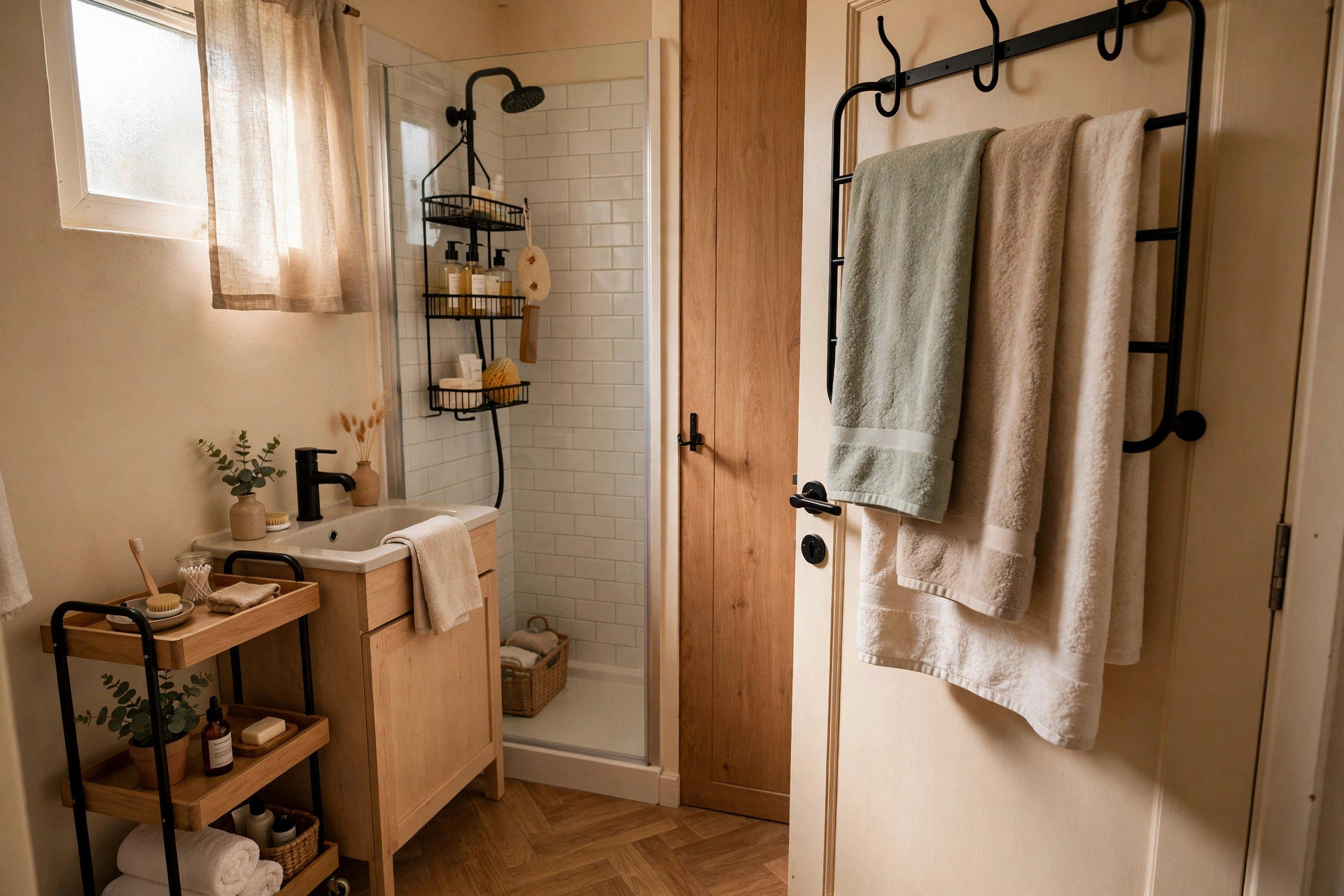
Checklist first, because tiny bathrooms do not reward guessing.
- Measure the gap beside the toilet and beside the sink. Write both down.
- Measure your shower: where can a caddy hang, and will the door or curtain still move.
- Look at your doors. Can a hook go over the top and still close.
- Count what you use daily. Not weekly. Daily.
- Check your lease for sticky pads, hooks, and any wall fix rules.
If you did that, you are ahead of most storage buys that end up too wide, too tall, or in the way. Tiny bathroom storage for renters is a special puzzle. You need more room. You cannot drill. You cannot rip out the vanity. And the room is damp, so half the sticky stuff falls off by Friday. This guide walks through the three tools that work most often: slim carts, shower caddies, and over-door systems. It builds on our main small kitchen and bathroom organization post, with a renter-first eye.
Start with what you own, not what you want to buy
Take everything out of the bathroom. Yes, all of it. Put it on a towel in the next room in groups. Daily face and teeth. Daily shower. Cleaning. Back-up and rare. Be a bit strict. Three half-used body washes is not storage need. That is stock you can use up before you buy a bigger rack. Back-up items can live outside the bathroom if they must — a hall closet, a bedroom box, under the bed. The bathroom only needs the open one and maybe one spare. This step tells you how much storage you truly need. Often it is less than you thought. Often the problem is not space. It is that back-up and rare items are taking the prime spots.
Slim carts: the gap fillers
A slim cart is a tall, narrow set of shelves on wheels that slides into a gap. Beside the toilet. Beside the sink. Between the washer and the wall if your bathroom holds the laundry too.
How to pick one
Measure the gap width, depth, and height. Leave a small breathing gap on each side so it can roll without scraping. Check the floor. Tile grout and a slope can make a cheap cart lean. Wheels that lock help, but even without locks, a cart loaded low will sit still. Open shelves are easy to grab from. Shelves with a low lip keep bottles from sliding off when you roll it. Closed slim cabinets hide mess but cost more and can feel bulky in a tiny room. Pick based on what you store. Towels and rolls look fine open. Mixed bottles look calmer in baskets on open shelves.
How to load it so it helps, not hurts
Daily items at hand height. Back-up below. Cleaning at the bottom if you keep it there, away from face items. Heavy bottles low. If the cart wobbles when you roll it, the load is top-heavy or the floor is uneven. Move weight down. Do not push a cart so tight to a damp wall that air cannot move. A small gap stops musty smells. Wipe the wheels now and then. Hair wraps around them in bathrooms. That is life.
Renter note
A cart needs no fix at all. That is its best trait. When you move, it rolls out. If it leaves a mark, it is just a floor clean, not a hole to fill. For more no-damage ideas across the home, see our renter-friendly upgrades.

Shower caddies: keep the wet zone calm
The shower is where small bathrooms fall apart. Bottles on the floor, bottles on the edge, one falls every time.
Hanging caddies
These hang over the shower head pipe or over a glass door or rail. Quick to put up, no fix. Check the fit. Some shower heads sit high, some low. A caddy that hangs too low puts soap at chest height and bumps you. One that hangs from a door needs the door to still open and close. Test with the caddy empty first, then with one bottle. Weight matters. Two big bottles plus a razor holder plus a scrub can pull a hanging caddy forward. It tilts, things slide. If yours tilts, take one heavy item out and store it just outside the shower. Not every bottle must live in the wet zone. Rust and soap scum are real. Rinse the caddy weekly. Pick a style you can lift off and rinse in the sink. If it cannot come off easy, you will not clean it. None of us do.
Corner and tension styles
Corner shelves with sticky pads can work on smooth tile, less well on rough tile or painted walls. Damp is their weak spot. Clean the tile, dry it full, and wait as long as the maker’s manual says for that exact pad and surface. If it falls in steam, it is not your fault. It is the wrong tool for that wall. Tension pole shelves press between floor or tub edge and ceiling. They can hold a lot of vertical space without screws. They need a solid top and bottom spot. A sloped ceiling or a soft tub edge can make them slip. Follow the maker’s steps for your exact pole and surfaces.
Suction styles
Small suction holders for a razor or a single bottle can help. As full storage, they often fail in a steamy small bathroom. Use them for light items only. Our no-drill shelves guide goes deep on why surface and manual checks matter more than any general claim. Same rule here.
Over-door systems: use the door you already have
The bathroom door and the inside of the vanity door are prime renter space. Hooks over the top. No holes.
Main bathroom door
An over-door rack with hooks can hold towels, a robe, or a hanging organizer with clear pockets for small items. Check the top gap. Some doors sit tight to the frame. A thick hook stops the close. Thin hooks are made for tight doors. Measure the gap if you can. Check the swing. Does the rack hit the wall or a towel rail when the door opens full. Does it rattle. A felt pad behind the rack where it meets the door can cut noise and rub. Keep the load even. All the weight on one hook side will twist a light rack. Do not hang heavy wet towels on a light door all day in a home with weak hinges. Hang them to dry, then fold to a shelf or cart when dry if your door feels strained.
Vanity door inside
Small pods or a thin rack inside the vanity door hold hair ties, cotton pads, and small tubes. Light only. Check pipe clearance behind it. And test the close. Vanity doors often have shelves close to the front. A thick rack blocks the close.
Put the three together: a tiny system that works
Here is a simple way to split jobs so they do not fight.
Cart = dry storage. Towels, spare rolls, back-up items, cleaning below.
Caddy = wet daily. Only what you use in the shower, only the open bottles.
Over-door = hang and grab. Towels in use, robe, small daily items in pockets.
Vanity inside = small daily. Teeth, face, hair small stuff.
When each tool has one job, you stop buying the same holder three times. You also clean faster. Wet stuff stays in the wet zone. Dry stuff stays dry.
What to measure before any buy
Gap width and depth for a cart, plus the turn space to roll it out. Shower head height and pipe type for a hanging caddy, plus door or curtain clearance. Door top gap and thickness for over-door hooks. Vanity inside depth and pipe spot. Take photos with the tape in them. Measure twice because bathroom tiles and pipes lie to your eyes. A cart that looks slim online takes real floor space. Head height on over-toilet or door racks matters too; you live with it daily.
Habits that keep a tiny bathroom calm
Put things back in their zone with wet hands in mind. If it is hard to put back, it will live on the sink edge. Use up back-ups before you buy more storage to hold more back-ups. That loop never ends. Wipe the cart top and the caddy once a week during your normal clean. Two minutes now saves a deep scrub later. Night reset in thirty seconds: hang the towel, put the toothpaste back, clear the sink edge. Wake up and the room feels bigger.
FAQ
How do I add storage to a small apartment without drilling or remodeling?
Use tools that stand, hang, or roll: slim carts, hanging shower caddies, and over-door racks. They need no wall fix and you can take them when you move. Measure the gaps first and check the maker’s manual for your exact item and surface.
Are over-door organizers worth it in a small apartment?
Yes, for towels, robes, and small pocket items. They use dead door space. Check the top gap so the door still closes, use felt pads to stop rattle, and keep the load light and even.
Why does my shower caddy keep falling?
Often the surface is damp, rough, or greasy, or the load is too heavy. Suction and sticky styles fail in steam. Try a hanging style over the head or door, lighten the load, and clean and dry the spot full before you try a pad again, as the maker states.
What should I store in a slim bathroom cart?
Daily dry items up top, back-ups in the middle, cleaning at the bottom. Keep heavy bottles low so it rolls steady. Use small baskets to stop bottles tipping.
How can I make a small room feel less cluttered without buying more storage?
Take back-up and rare items out of the bathroom, use up what you have, give wet and dry items apart zones, and do a thirty-second night reset. Often you need less storage, not more, once the stock is out of the prime spots.
How we made this guide
We wrote this with renter rules in front: no drill fix, nothing that risks a deposit if we could help it, measure gaps and door tops before any buy, and check the maker’s manual for the exact cart, caddy, or rack and your wall or door type. Damp bathrooms break a lot of storage claims, so we tell you what to test at home instead of promising one product fits every tile and door.
By InterestBlog24 Editorial Team.