
The question is not “can I fit a desk.” You can almost always fit a desk. The question is “can I still open my drawers, get to the closet, and make the bed without moving the chair each time.” In a small bedroom, a desk steals more than floor space. It steals swing space. Drawer swing, door swing, your own swing when you sit down and push back. Miss that and the desk works on day one and drives you mad by day seven. This post helps you place a desk so work and storage stop fighting. It pairs well with our studio apartment layout ideas because a studio bedroom zone has the same tight math.
Measure these five things before you shop or move
Get a tape. Get your phone notes. Do not eyeball a small bedroom. Eyes lie in tight rooms.
One, the wall run. Measure the wall where the desk might go, minus skirting and any radiator or pipe that sticks out. That is your true width.
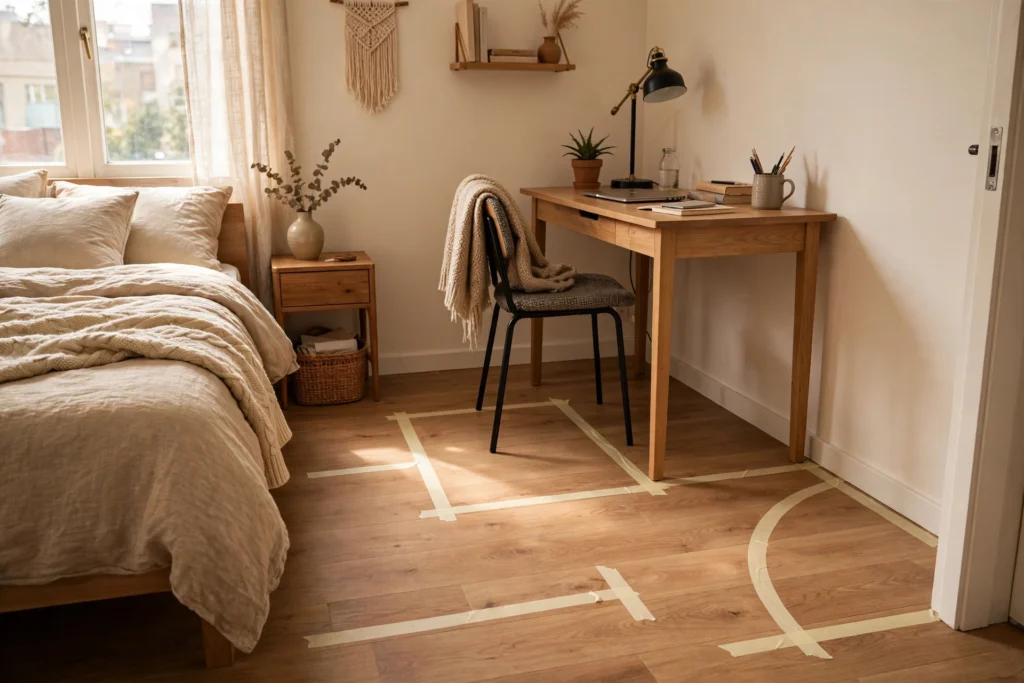
Two, door and drawer swings. Open every drawer, closet door, and the room door full. Mark where they reach on the floor with tape. A desk or chair in that arc will block storage. That is the number one small bedroom desk fail.
Three, bed clearance. You need to walk beside the bed and pull sheets. Measure the gap between bed edge and wall. If a desk chair will sit in that gap, measure chair depth plus your sit space. Sit on your bed edge and stand up. That move needs room.
Four, plug spots. Where are the sockets. A desk far from a plug means cords across the floor or across the bed. Cords across a walk path in a small room are a trip and a visual mess.
Five, light. Window spot and lamp spot. A desk facing a bright window can glare on a screen. A desk in a dark corner needs a lamp, which needs surface space and a plug.
Write the numbers. Take a photo of the tape on the floor. That photo will save you a return trip.
The four desk spots, ranked for small bedrooms
Spot one: along the same wall as the door
Often the best. You walk in, desk is to one side, bed is clear, closet swing is on another wall. Work zone and sleep zone sit apart. Keep the desk depth modest so the walk path from door to bed stays clear. Watch the door swing. The room door itself takes an arc. Your chair cannot live in it.
Spot two: at the foot of the bed, if the room is long
Works in a long, narrow room. Desk faces the bed or faces a wall at the foot end. You gain a clear wall run. You lose foot-of-bed walk space. Test it: can you still walk around the foot to the other side of the bed without turning sideways each time. If not, it will grate.
Spot three: in place of a bedside table
Swap one bedside table for a small desk. You sit on the bed edge side or on a small chair that tucks full under the desk. This is a tight but real fix for a very small room. Storage loss is the trade: give that bedside items a new home first — a wall shelf, a drawer, a basket — or the desk top becomes the bedside pile.
Spot four: in the closet nook, if you have one
Some small bedrooms have a closet nook or an alcove that is too small for a full wardrobe but just right for a desk. Door off, desk in. It feels like a small office. Check plug access and light. And think hard before you give up clothes storage. Our how to create clothes storage with no closet post can help you move clothes storage elsewhere first if you go this way.
Desk shape and size: what to think about
We will not tell you a universal desk size. Bodies, chairs, and rooms differ. Instead, test with tape. Tape the desk top size on the floor or on a table you own. Put your laptop, notebook, mug, and lamp on the tape. Is there rest space. Can you write without pushing the laptop half off. If the tape test feels cramped on a table, the real desk will too. Depth is the make-or-break number. A deep desk in a small bedroom pushes your chair into the bed or blocks a drawer. A narrow desk can work if you use a laptop and one notebook. If you use a separate monitor, keyboard, and papers, you need more depth or a way to raise the monitor so the keyboard slides under it. Measure your gear, not a showroom set. Legs matter. Four thick legs eat floor and bump storage boxes. A desk with slim legs or a top fixed to the wall (if you own and can fix) frees the floor. If you rent, a freestanding slim-leg desk is safer than a wall fix. Check what your lease allows. Height: sit at your tape test. Feet flat, arms at a comfortable typing bend. If you test on a dining table, note it is often higher than a desk. A chair that adjusts helps, but it also takes more floor space when it rolls back. In a tiny room, a small chair that tucks full under the desk is gold.
Keep storage reachable: the rules
Rule one: no storage behind the chair. If you have to move the chair and squeeze each time you need a drawer, you will stop using that drawer. It becomes dead storage and the room feels smaller.
Rule two: daily storage at the desk, rare storage elsewhere. Daily work items in the desk drawer or a small box on the desk. Rare items — old files, spare cables — can live under the bed or high in the closet. Our multi-functional furniture guide covers desks and beds that hold storage inside them, which helps when floor is gone.
Rule three: chair tucks away. When work ends, the chair should push in so the walk path clears. If it cannot tuck because a storage box sits under the desk, move the box. Under-desk space is chair space first.
Rule four: vertical storage near the desk. A shelf above the desk (if you can fix it or use a freestanding shelf that sits on the desk) keeps books and boxes off the top. Keep the shelf light in feel. A heavy row of boxes above your head while you work feels cramped. One or two open shelves, not a wall of storage.
Cords, light, and daily calm
Run cords down the desk leg nearest the plug, along the wall, not across the floor. A small cord clip or box keeps them in one line. In a small bedroom you see every cord. One clean line calms the room. Lamp: pick one that clamps to the desk edge or stands with a small base. A big lamp base eats your writing space. Test the light at night. Does it glare on the screen. Does it light the notebook. Move the lamp, not the whole desk, first. Chair mat: on hard floors a chair can scrape and slide into storage. A thin mat keeps it in place and cuts noise for anyone below you. Measure the chair roll-back space before you get one.
A simple test weekend
Do not buy first. Live with a fake desk for two days. Use a small table you own, or tape the size on your dining table and work there with your bedroom chair. At night, note: could you open every drawer. Could you get to the closet without moving the chair. Could you make the bed. Could you walk to the door in the dark without hitting the desk corner. If the answer is no three times, the spot or the size is wrong. Move the tape, not your money. When you find a spot that passes, take photos from the door and from the bed. That door view tells you if the room still feels like a bedroom, not an office with a bed in it. Both matter if you sleep there. Sleep note: if work stress follows you, a small close-down habit helps. Close the laptop, put work items in one box, push the chair in. The desk reads as closed. Small room, clear signal.
FAQ
How do I store clothes in a small apartment with no closet?
Use a mix of under-bed boxes for rare items, a slim rail or over-door hooks for daily items, and drawer space kept clear of work gear. Keep the desk zone apart from the clothes zone so one does not block the other. Measure drawer swings before you place a rail or desk.
What desk depth works for a small bedroom?
The right depth is the one that holds your gear with rest space and still lets your chair tuck and drawers open. Tape the size, place your laptop, notebook, and lamp on the tape, and test typing and writing. If it feels tight on tape, it will feel tight for real.
Can I put a desk in front of a window in a small bedroom?
You can, but check glare, heat, and radiator spots. A window desk can block light to the rest of the room if the desk and monitor are tall. Test with a table for a day at the hours you work.
How do I stop the desk from taking over the bedroom?
Give work items one drawer or box. At day end, everything work goes in it, laptop closed, chair tucked. Keep bed items off the desk and desk items off the bed. A clear top at night helps the room feel like a bedroom again.
What should I store under a bed, and what should not go there?
Under the bed is good for rare or flat items in closed boxes: spare bedding, off-season clothes, files you rarely need. Do not put daily work files or daily clothes there if you have to move the desk chair and lie on the floor each time to reach them.
How we made this guide
We based this on measures you can take at home: wall run, swing arcs, bed clearance, plug spots, and a tape test with your real gear. We do not give one desk size for all rooms because chairs, bodies, and gear differ so much. The maker’s manual for your exact desk and chair will carry their size and build notes; your tape test will tell you if that size fits your storage swings.
By InterestBlog24 Editorial Team.