
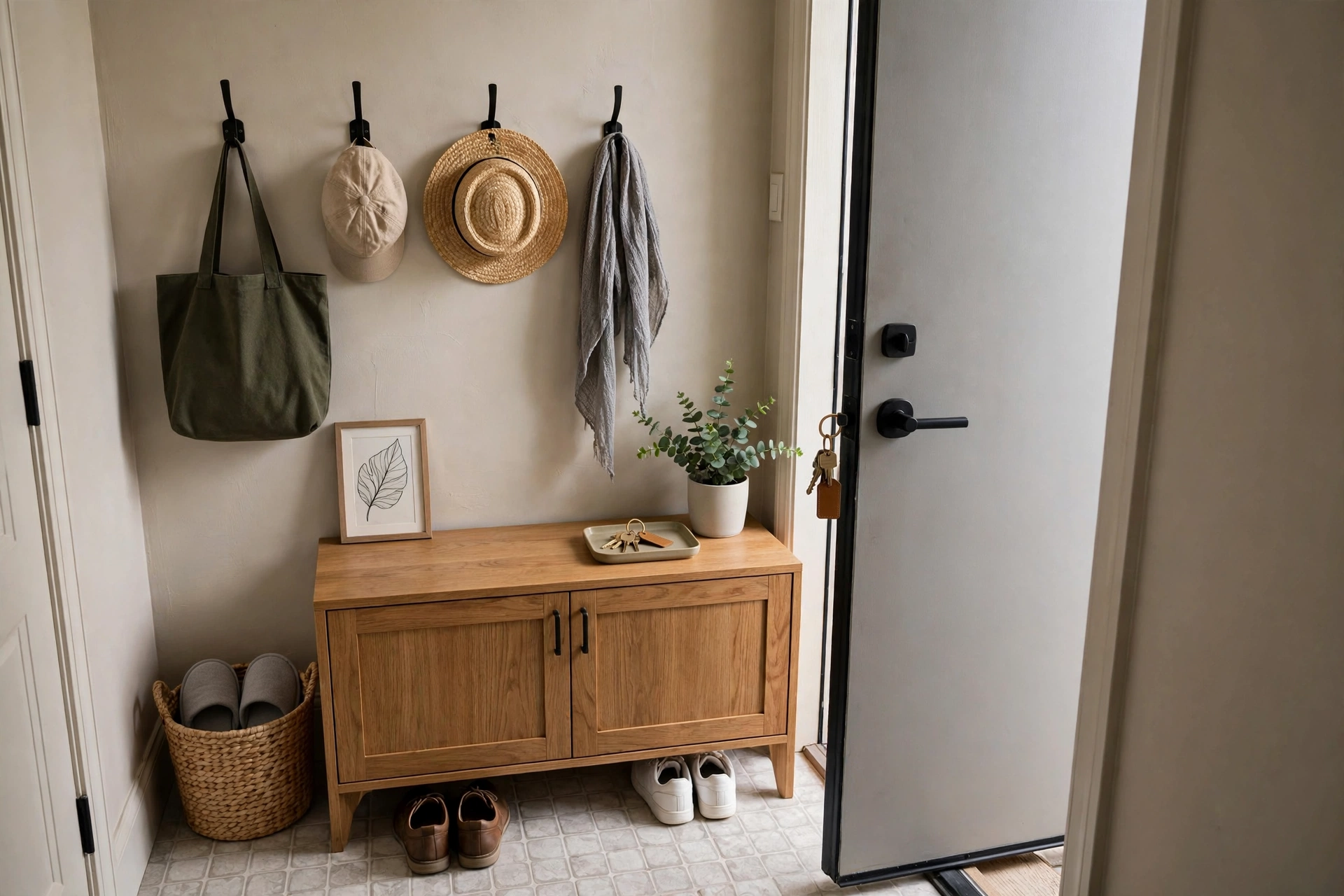
You open the door with a bag in one hand and keys in the other. There’s nowhere to put a thing down. Coats land on a chair. Shoes line up on the floor. Keys end up on the kitchen side, lost by morning. That’s not a tidiness flaw. The door has no home for what you use each day. Fix that one spot and the flat calms down. You don’t need a big unit. You need three small homes by the door, easy to use with one hand. All picks here are renter-safe — they stand on the floor, hook over a door, or come off clean.
Three homes by the door
Keep three jobs apart. One piece that does all three does none well. Hang — up high: coats, bags, hats and leads near the door, at about shoulder height. Drop — one fixed spot: keys, phone, wallet and mail. Same spot each time. Shoes — down low: one rack or box so shoes don’t creep into the room. Hooks up top, tray in the mid, shoes low. That’s the whole plan, even on one short wall.
Measure first
Don’t start with photos. Grab a tape — five mins now saves a bad buy. Wall width you can use, minus the door frame. Door swing. Open it wide. Keep tall things out of that path. Depth you can spare and still walk past. For most small halls that’s about 25 to 30 cm. Test with a box. Count what lives at the door now — coats, shoes, bags, mail, lead. Write it down. Buy for that real list.
Hang spot
Coat stand in a corner: it takes about a plate’s worth of floor and holds coats tall, not flat. Get a wide, heavy base and spread coats round it so it won’t tip. Best in a corner. Hooks over the door: no holes, coats right where you shed them. Test first — set the bar on and shut the door slow. Some doors won’t shut with a rack on. Keep only coats in use on it. Short rail, if your lease lets you: small picture holes only, if the lease says yes. If holes aren’t allowed, skip it. Clothes rack in a studio: a slim rack on wheels by the door can hold coats and spare clothes. Same plain hangers and a cover read as storage, not laundry.
Drop spot for keys and mail
Small is good here. A wall pocket, a tray on a shoe cabinet, or a magnetic strip inside a cupboard door all count. One spot, each time, even on tired nights — that’s the rule that works. Mail needs a call, not a big box. A slim holder for mail to act on this week, the rest recycled at the door. If paper drifts round the flat, tie it to a short weekly tidy — we lay out a five min reset in our small home cleaning and declutter routines guide.
Shoe spot
Closed cabinet: flat tilt-out cabinets hide shoes, cut dust, and the top doubles as your drop spot. Check swing room in front twice before you buy. Open rack if space is tight: under about 20 cm deep, a low two-tier rack beats shoes loose. Boots and chunky trainers often fit best under the bed — see under-bed storage ideas for low bed frames for how to check the gap. Mat that draws the line: a low washable mat catches grit, marks where shoes stop, and guards the floor. Shake it out each week.
Fit it to your hall
Straight wall: shoe cabinet on the wall, hooks on the door, tray on the cabinet top. Flat to the wall, door still swings free. Studio corner: stand in the corner, rack at a right angle, pocket for keys. The corner reads as an entry, which helps a studio feel zoned. Door into the kitchen: drop spot first — pocket by the door so keys and mail don’t hit the bench — then a shoe rack. Coats on a rack in the living space. The same zone trick helps benches too, in our small kitchen and bathroom organization guide.
Swap with the seasons
A spot built for autumn drowns in winter if nothing leaves. Twice a year, move off-season coats and shoes out — box on a cupboard, case under the bed. The door holds this month’s weather only. Same idea as our main small apartment storage ideas guide: a home per type of thing, not a bigger box. If clothes with no closet is the real gap, use how to create clothes storage with no closet first, then redo the door with what’s left.
Slips that make it worse
Bench first: eats depth, collects bags, blocks the swing. Add a seat last. One giant hall tree: built for houses. In a flat it eats the wall and keys stay lost. Hooks at the wrong height: long coats pool on shoes or bags bang the wall. Cleaning gear at the door: first step feels like a cupboard. Heavy rail, weak fix: a loaded rail pulls hard. If screws are banned, use a stand.
Weekly reset and first buy
Ninety secs once a week: shoes back, coat off the chair, mail cleared, mat shaken. Halls fail from five small things left out daily, not bad buys. Keys in the drop spot each time — that dull habit beats new gear. Buy order: hang spot first (coats are the loudest mess), drop spot next (lost keys waste mornings), shoes last.
Door spot questions
What depth cabinet fits a small hall? Check your depth and swing. Many flat cabinets sit at about 17 to 30 cm, but that’s a range to check per listing, not a pledge. Cardboard-test the floor size before you order. Are over-door hooks safe on rental doors? Often yes, if the door shuts clean with the bar on and you don’t overload it. Test the shut empty first. How many coats at the door? What’s in use now — two or three each, max. Can stick-on hooks hold coats? Light caps, leads and one thin jacket only, and only inside what the maker states for that hook on that wall. Heavy winter coats on adhesive are the classic 3 a.m. crash — pick a stand. No wall at all? Work a corner — stand plus rack as a pair, tray on the rack for keys, rug to draw the line.
How we build these guides
We work from maker sizes, care notes and checks you can redo at home — cardboard floor tests, door swing checks. We don’t claim tests we haven’t done. Check your lease and each product manual for limits for your walls, doors and floors.
By InterestBlog24 Editorial Team.